Sunday, July 31, 2016

Sweden: Afghani Muslim Refugee Rapes Two 10-Year-old Swedish Boys at Swimming Pool


Little boy crying 17

by, Fria Tider

An unaccompanied refugee who, according to witnesses is a grown man, is accused of raping a boy about ten years old and sexually molesting another in Härnösands swimming pool.

The boys were visiting the bathhouse April 5 this year when they were abused by the Afghan man.

According to the indictment, one of the boys subjected to an oral rape, while the other was sexually molested when Afghan committed anal rape. Both boys are ten years old.

Sweden - Swimming Pool 2
Härnösands swimming pool, location of the child-rapes.

The defendant lives in Sweden as an unaccompanied refugee and initially claimed the he was 17 years old. According to an eyewitness who will be heard during the trial, the Afghani stated that he was really over 20 years old.

The prosecutor claims that the man should be deported back to Afghanistan after serving his sentence.


Denmark to Consider Proposal Banning All Muslims From Entering the Country


this summer’s terrorist attacks in Europe, Danish politician Søren Espersen has proposed all immigration from Muslim countries should be completely stopped in Denmark.

The American presidential candidate Donald Trump has attracted attention through his proposal to ban entry for Muslims.

Now, Søren Espersen, a journalist and member of  “The Danish People’s Party” has made a similar proposal in Denmark.

“We must, for a long time – perhaps four to six years – absolutely refuse to accept refugees and immigrants from Muslim countries, until we have an overview of our future efforts,” writes Espersen in a debate article in Berlingske.

The politician also proposes measures against Muslims that are already in Denmark. Among other things, he wants to tear up the citizenship of the imams who preach violence and make it an obligation for Muslim communities to report to the authorities if they notice that a young person shows signs of radical jihadism.


Department of Homeland Security Targeting the Wrong Enemy


  • President Obama has surrounded himself not with military strategists but rather with fiction writers, wide-eyed diplomats whose strategy is "don't do stupid shit," and law enforcement officials who believe that "Our most effective response to terror and hatred is compassion, unity and love."
  • Only "rightwing extremism" is obvious to the Obama Administration. Everything else is apparently too complex and nuanced for labels. Even Micah Xavier Johnson, who said that he was motivated by "Black Lives Matters" rhetoric and hatred of white people, is a conundrum to the president, who bizarrely asserted that it is "hard to untangle the motives of this shooter."
  • The Obama era is one of willful blindness to the jihadist movement that has declared war on America. CIA Director John Brennan purged the word "jihad" from the agency's vocabulary. Obama's two Attorneys General have done the same at the Department of Justice.
  • The federal government has spent the last 8 years pretending that "rightwing extremists" are more numerous and dangerous than the careful and intelligent jihadist attackers, whom it insists are just "madmen" or "troubled individuals."
Anyone surprised by President Barack Obama's recurring attempts at exploiting jihadist attacks in his efforts to restrict gun ownership should read the earliest known document concerning terrorism assembled by his administration. The unclassified assessment by Department of Homeland Security (DHS), titled "Rightwing Extremism: Current Economic and Political Climate Fueling Resurgence in Radicalization and Recruitment," is dated April 7, 2009 -- a mere 77 days after Obama's inauguration.
The document was leaked shortly after its release to law enforcement officials across the country and made public by Roger Hedgecock on April 13, 2009. It laid out the new president's legislative and executive priorities on terrorism, guns and immigration. Uniquely combining these three issues would become a predictable, coordinated pattern during Obama's two terms in office.
The assessment boldly delineated the Tom Ridge and Janet Napolitano eras at the DHS. As Eli Lake wrote the day after the document was leaked, "Since its inception in 2003, the department has focused primarily on radicalization of Muslims and the prospect of homegrown Islamist terrorism." Under Obama's leadership, attention was directed away from Muslims and Islamist terrorism and redirected towards limiting the Second Amendment, scrutinizing military veterans and expanding both legal and illegal immigration.
Contrary to criticism of the Obama administration as uninterested in the plight of military veterans, the DHS assessment shows that vets were very much a priority. The document's authors, in fact, were worried that "military veterans facing significant challenges returning into their communities could lead to the potential emergence of terrorist groups or lone wolf extremists."


The only significant acts of domestic terrorism perpetrated by veterans lately have not been inspired from the right, however: Micah Xavier Johnson and Gavin Long are products of a "left wing," anti-police, anti-establishment ideology. The assassinations they carried out fit the pattern of the so-called "New Left" wave of terror carried out in the 1970s by the Weather Underground and the Black Panthers.
The language of the document also foretells the Obama story. In its brief seven pages of text there are 25 references to gun control, weapons and ammunition-hoarding. Terrorists motivated by "anti-immigration" and "white supremacist" ideologies are mentioned 11 times, and veterans returning home from Afghanistan and Iraq are mentioned 9 times. Variations of "extremism," which would become Obama's preferred euphemism, occur 42 times.
Timothy McVeigh is the model terrorist in the document. DHS spokeswoman Sara Kuban said a goal of the report was "to prevent another Tim McVeigh from ever happening again."
The 1990s figure prominently in the DHS prognostication, meriting 17 references. The "poor economic climate," the Clinton "assault weapon" ban and "a perceived threat to US power and sovereignty by other foreign powers" are envisioned as parallel to the situation in 2009. Looking back at the 1990s and predicting similar troubles in the age of Obama, Napolitano's DHS made no mention of the most significant development in the evolution of political violence to occur in the 1990s: the rise of Al-Qaeda.
Military strategists worth their pay will recognize the DHS version of "preparing to fight the last war," but then Obama has surrounded himself not with military strategists but rather with fiction writers, wide-eyed diplomats whose strategy is limited to "don't do stupid shit," and law enforcement officials who believe that "Our most effective response to terror and hatred is compassion, unity and love."
In a passage about "the historical election of an African American president and the prospect of policy changes," there is a reference to "the shooting deaths of three police officers in Pittsburgh, Pennsylvania, on 4 April 2009." The shooter in question was Richard Poplawski, who ambushed the police called to his home to investigate a domestic disturbance. The DHS concludes that "his racist ideology and belief in antigovernment conspiracy theories" led to his "radicalization," though years later, after Poplawski was convicted and sentenced to death, reporters and even the jury were still unsure of his motives.
The Poplawski shooting occurred just three days before the date on the document. Compare that remarkably speedy conclusion to the way the Obama Administration has handled jihadist attacks. Maj. Nidal Malik Hasan's November 5, 2009 attack in Fort Hood, Texas, and Alton Nolan's September 24, 2014 ritual beheading of a coworker at the Vaughan Foods plant in Moore, Oklahoma, are described as "workplace violence."
FBI Director James Comey expressed confusion over Omar Mateen's motives for the recent Orlando jihad attack, even though Mateen's attack was accompanied by the jihadist's battle cry "Allahu Akhbar" and a pledge of allegiance to Abu Bakr al-Baghdadi, Caliph of the Islamic State during a 911 call. Before that it was the San Bernardino husband-wife jihadist team whose motives were ostensibly a mystery to the FBI.
Only "rightwing extremism" is obvious to the Obama Administration. Everything else is apparently too complex and nuanced for labels. Even Micah Xavier Johnson, who told Dallas police that he was motivated by "Black Lives Matters" rhetoric and hatred of white people, is a conundrum to the president, who bizarrely asserted that it is "hard to untangle the motives of this shooter."
Left: The 2009 Department of Homeland Security assessment titled "Rightwing Extremism: Current Economic and Political Climate Fueling Resurgence in Radicalization and Recruitment." Right: Micah Xavier Johnson, who murdered five Dallas police officers and injured nine others, said that he was motivated by "Black Lives Matters" rhetoric and hatred of white people.

After the 2009 DHS assessment was widely and rightly criticized, the Southern Poverty Law Center (SPLC) complained that the administration "let its team devoted to non-Islamic domestic terrorism fall apart in the aftermath of... [the] controversial leaked report." But while the "Extremism and Radicalization Branch, Homeland Environment Threat Analysis Division" may have been dropped, but the principles that led to the document were not.
Even more so than the Bush era, the Obama era is one of willful blindness to the global jihadist movement that has declared war on America. CIA Director John Brennan purged the word "jihad" from the agency's vocabulary. Obama's two Attorneys General have done the same at the Department of Justice.
The federal government has spent the last eight years pretending (maybe even believing) that "rightwing extremists" are more numerous and dangerous than the careful and intelligent jihadist attackers, whom it insists are just "madmen" or "troubled individuals."

Germany: Christian Names for Muslim Migrants?


  • "The United States is full of anglicized German names, from Smith to Steinway, from Miller to Schwartz. The reason: integration was made easier. ... I think that German citizens of foreign origin should also have this possibility." — Ruprecht Polenz, former secretary general of Germany's ruling Christian Democratic Union.
  • Non-Muslim immigrants generally choose traditional German names for their children to facilitate their integration into German society. By contrast, Muslim immigrants almost invariably choose traditional Arabic or Turkish names, presumably to prevent their integration into German society. A 2006 study found that more than 90% of Turkish parents give their German-born children Turkish first names.
  • A 2016 study found that 32% of ethnic Turks in Germany agree that "Muslims should strive to return to a societal order such as that in the time of Mohammed." More than one-third believe that "only Islam is able to solve the problems of our times." One-fifth agree that "the threat which the West poses to Islam justifies violence." One-quarter believe that "Muslims should not shake the hand of a member of the opposite sex."
Muslim migrants in Germany who feel discriminated against should be given the right to change their legal names to Christian-sounding ones, according to a senior German politician.
The latest innovation in German multiculturalism is being championed by Ruprecht Polenz, a former secretary general of the ruling Christian Democratic Union (CDU). He believes the German law which regulates name changes (Namensrecht) should be amended to make it easier for men named Mohammed to become Martin and women named Aisha to become Andrea.
German law generally does not allow foreigners to change their names to German ones, and German courts rarely approve such petitions. By custom and practice, German names are only for Germans.
According to Polenz, who served as a member of parliament for nearly two decades, the law in its current form is "ignorant" and should be changed:
"An ignorant law: the United States is full of anglicized German names, from Smith to Steinway, from Miller to Schwartz. The reason: integration was made easier. It no longer appeared as though a family was not from the USA. I think that German citizens of foreign origin should also have this possibility."
Polenz elaborated:
"The desire to adopt a German name is solid evidence that you feel German and would like to be seen as a German. In the context of integration this is entirely desirable. It simply does not make sense to prohibit this....
"In everyday life we ​​unfortunately often see that naturalization or possessing a German passport is not enough to be regarded as a German."
Muslims with foreign-sounding names often find it difficult to find a job, Polenz said, and the possibility of a name change might prevent discrimination and promote integration.
Indeed, academic studies (here and here) have found that immigrants with Arab or Turkish last names are less likely to be invited to job interviews than equally qualified migrants with non-Muslim sounding names.
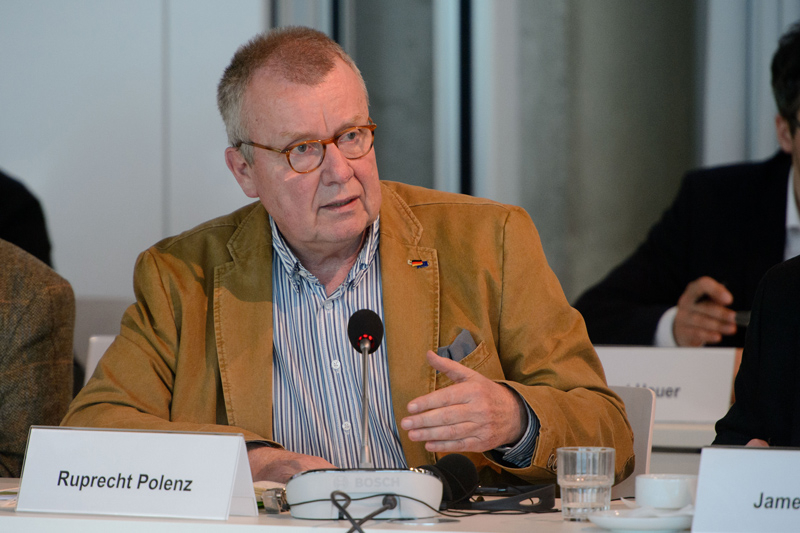
Ruprecht Polenz, a former secretary general of Germany's CDU party, believes the German law which regulates name changes should be amended to make it easier for Muslim migrants to change their legal names to Christian-sounding ones. (Image source: stephan-roehl.de/Flicker)

The former president of the Constitutional Court in North Rhine-Westphalia, Michael Bertram, has called for German courts to allow a name change if "a foreign-sounding name makes it difficult to integrate into the economic and social life in this country."
He was referring to a case in which a court in Braunschweig rejected a petition by a German-Turkish family to change their surname. The parents had complained that in school their German-born children were being treated as "educationally disadvantaged migrants" and that teachers were addressing them in Turkish, a language they did not understand because they only speak German at home.
The court insisted on the principle of "name continuity" (Namenskontinuität) because there is "a public interest in maintaining the traditional name to enable social orientation and identification for security purposes."
In a precedent-setting case in May 2012, a court in Göttingen ruled that neither the fear of discrimination, nor the desire for integration, are sufficient legal grounds for migrants to change their names to German ones.
The case involved a family of asylum seekers from Azerbaijan who wanted to adopt German first and last names to prevent possible discrimination and to avoid being linked to a particular ethnic or religious group.
The court ruled that although discrimination due to a foreign-sounding name was always a possibility, it is not within the purview of the law that regulates names to "counteract a social aberration" (gesellschaftlichen Fehlentwicklungen), i.e., discrimination.
The court added that the plaintiff's names were not any more or less unusual than those of the majority of other migrants living in Germany. Moreover, although the children had Muslim-sounding names, it would not pose a big problem because others would not necessarily associate them with active religious practice.
Even if the existing German law were changed, it is unlikely that many Muslim migrants would adopt Christian names. Muslims who have children in Germany are already free to give them German first names, but they rarely do.
According to the Center for Onomatology (the study of the origin of names) at the University of Leipzig, Muslim and non-Muslim immigrants differ substantially in the way they choose names for their German-born children.
Non-Muslim immigrants generally choose traditional German names for their children to facilitate their integration into German society. By contrast, Muslim immigrants almost invariably choose traditional Arabic or Turkish names, presumably to prevent their integration into German society.
While non-Muslim immigrants name their children Sophie or Stefan, Muslim immigrants — including those whose families have been living in Germany for two, three or four generations — overwhelmingly give their children Muslim names such as Mohammed, Mehmet or Aisha.
A 2006 study produced by the University of Berlin found that more than 90% of Turkish parents give their German-born children Turkish first names; fewer than 3% give them German names.
A 2012 study found that 95% of ethnic Turks living in Germany believe it is absolutely necessary for them to preserve their Turkish identity. Nearly half (46%) agreed with the statement, "I hope that in the future there will be more Muslims than Christians living in Germany." Only 15% consider Germany to be their home.
A 2016 study found that 32% of ethnic Turks in Germany agree that "Muslims should strive to return to a societal order such as that in the time of Mohammed." More than one-third (36%) believe that "only Islam is able to solve the problems of our times." One-fifth (20%) agree that "the threat which the West poses to Islam justifies violence." One-quarter (23%) believe that "Muslims should not shake the hand of a member of the opposite sex."
Some politicians believe that giving Muslim migrants the right to adopt Christian-sounding names will ease their integration into German society. But empirical evidence shows that most Muslims in Germany do not want German names and many have no desire to integrate into German society.

Will Europe Refuse to Kneel like the Heroic French Priest?


Turkey's Tradition of Murdering Christians


  • Turkey's countless agreements with Western organizations do not seem to have reduced the hatred for Christians there.
  • In Turkey, it is "ordinary people" who murder or attack Christians, then the judiciary or political system somehow find a way of enabling the perpetrators to get away with the crimes. Most of these crimes are not covered by the international media and Turkey is never held responsible.
  • While Muslims are pretty much free to practice their religion and express their views on other religions anywhere in the world, Christians and other non-Muslims can be killed in Turkey and other Muslim-majority countries just for attempting peacefully to practice their religion or openly express their views.
  • "Multiculturalism," which is passionately defended by many liberals in the West, could have worked wonders in multi-ethnic and multi-religious places such as Anatolia. But unfortunately, Islamic ideology allows only one culture, one religion, and one way of thinking under their rule: Islam. Ironically, this is the central fact these liberals do not want to see.
On 26 July, the northern French town of Saint-Étienne-du-Rouvray witnessed a horrific Islamist attack: Two Islamic State (ISIS) terrorists killed an 85-year-old priest, Jacques Hamel, in his church during Mass. Two nuns and two churchgoers were taken hostage.
The terrorists, who had pledged allegiance to ISIS and, shouting "Allahu Akbar", slit the throat of the priest and captured the bloody episode on video, according to a nun who escaped the assault.
Such Islamist attacks might be new to EU member countries but not to Turkey. For decades, so many innocent, defenseless Christians in Turkey have been slaughtered by Muslim assailants.
Christians in Turkey are still attacked, murdered or threatened daily; the assailants usually get away with their crimes.
In Malatya, in 2007, during the Zirve Bible Publishing House massacre, three Christian employees were attacked, severely tortured, then had their hands and feet tied and their throats cut by five Muslims on April 18, 2007.
Nine years have passed, but there still has been no justice for the families of the three men who were murdered so savagely.
First, the five suspects who were still in detention were released from their high-security prison by a Turkish court, which ruled that their detention exceeded newly-adopted legal limits.
The trial is still ongoing. The prosecutor claims that the act "was not a terrorist act because the perpetrators did not have a hierarchic bond, their act was not continuous and the knives they used in the massacre did not technically suffice to make the act be regarded as a terrorist act."
If the court accepts this legal opinion of the prosecutor, it could pave the way for an acquittal. However, given the many "mysterious" rulings of the Turkish judiciary system to acquit criminals, these killers could also be acquitted by a "surprise" ruling any time.
Ironically, Turkey's President Recep Tayyip Erdogan said in March that it is necessary to redefine terrorism to include those who support such acts, adding that they could be journalists, lawmakers or activists. There was no difference, he said, between "a terrorist holding a gun or a bomb and those who use their position and pen to serve the aims" of terrorists.
In a country where state authorities are outspokenly so "sensitive" about "terrorism" and "people holding guns," why are the murderers of Christians not in jail, and why is the prosecutor trying to portray the murders of Christians as "non-terroristic acts"?
Sadly, the three Christians in Malatya were neither the first nor the last Christians to be murdered in Turkey.
On February 5, 2006, Father Andrea Santoro, a 61-year-old Roman Catholic priest, was murdered in the Santa Maria Church in the province of Trabzon. He was shot while kneeling in prayer at his church. Witnesses heard the 16-year-old murderer shout "Allahu Akbar" ("Allah is the Greatest") during the murder.
After the murder, a 74-year-old priest, Father Pierre François René Brunissen, from Samsun, led the next church service in Santoro's church, which boasted barely a dozen members. Because no one volunteered to replace Santoro, Father Pierre was instructed to travel from Samsun to Trabzon each month to care for the city's small congregation.
"This is a terrible incident," Father Pierre said. "It is a sin to kill a person. After all of these incidents, I am worried about my life here."
In July, 2006, he was stabbed and wounded by a Muslim in Samsun. The perpetrator, 53, said that he stabbed the priest to oppose "his missionary activities."[1]
The attacks against the Christian culture in Anatolia continue in modern times -- even after Turkey joined the Council of Europe in 1949 and NATO in 1952.
Turkey's countless agreements with Western organizations do not seem to have reduced the hatred for Christians there. In March, 2007, as the Christian community of Mersin was preparing for the Easter, a young Muslim man with a kebab knife entered the church and attacked the priests, Roberto Ferrari and Henry Leylek.
Mersin, in southern Turkey, is home to Tarsus, the birthplace of Saint Paul, and to several churches dating from the earliest Christian era.
As the Christian roots of Anatolia weakened, so did its bonds with Western civilization. "The attack against the priest is an indicator that Ankara is not ready for Europe," a Roman Catholic Cardinal and theologian, Walter Kasper, told the Italian newspaper, Corriere della Sera. "There is some amount of tolerance but there is not real freedom. Turkey has to change many things. This change is not about laws. A change of mentality is needed. But you cannot change mentality in one day."
Bishop Luigi Padovese, Apostolic Vicar of Anatolia, said: "We do not feel safe. I am very worried. Fanaticism is developing in some groups. Some people want to poison the atmosphere and catholic priests are  targeted. Anti-missionary films are broadcast on TV channels."
At a commemorative ceremony for Father Santoro in February, Bishop Padovese said:
"Today, we are asking the question we asked four years ago: Why? We are also asking the same question for all other victims so unjustly murdered even though they were innocent. Why? What was it that they tried to destroy by murdering Father Andrea? Just a person or what that person represented? The aim of shooting Father Andrea was definitely to shoot a Catholic cleric. His being a Father became the reason of his martyrdom.
"The message of Christ on the cross is clear. 'Father, forgive them, for they do not know what they do.' Had they known, they would not have done that. It is wrong to extinguish a life to uphold an idea. It is wrong to think that a person who disagrees with us is at fault and should be destroyed. This is the fundamentalism that crumbles a society. For it wrecks coexistence. This fundamentalism -- regardless of what religion or political view it belongs to -- might win a few battles but it is doomed to lose the war. This is what history teaches us. I hope that this city and this country will turn into a place where people can live as brothers and sisters and unite for the common good for all. Is the Allah of all of us not the same?"
No, unfortunately, the Allah of all of us is not the same.
Just four months later, in June, 2010, it was Padovese's turn to be murdered. This time the murderer was the Bishop's own driver for the previous four years. The driver first stabbed the bishop, then cut his throat, while shouting "Allahu Akbar" during the attack.
At the trial, the driver said that the bishop was "Masih ad-Dajjal" ("the false messiah"), then twice in the courtroom he loudly recited the adhan (Islamic call to worship).
Father Andrea Santoro (left), a 61-year-old Roman Catholic priest, and 63-year-old Bishop Luigi Padovese (right), Apostolic Vicar of Anatolia, were two Christian priests murdered in Turkey in recent years.

In the territory where Christians once thrived, even converting to Christianity now creates serious problems.
"New Christians coming from Muslim families are often isolated and ostracized," writes Carnes. "Turgay Ucal, a pastor of an independent church in Istanbul, who converted from Islam to Christianity said: "Buddhism is okay, but not Christianity. There was a history."
And this history includes how indigenous Christians in Anatolia have been slaughtered by Muslims. [2]
The total population of Turkey is about 80 million; believers of non-Muslim faiths -- mostly Christians and Jews -- comprise 0.2%. Nevertheless, anti-Christian sentiment is still prevalent in much of the Turkish society. [3]
There seems to be a pattern: Murders of Christians are committed stealthily in Turkey: It is "ordinary people" who murder or attack Christians, then the judiciary or political system somehow finds a way of enabling the murderers or attackers to get away with what they have done. Sadly, most of these crimes are not covered by the international media, and Turkey is never held responsible.
Turkey, however, signed a Customs Union agreement with the European Union in 1995 and was officially recognized as a candidate for full membership in 1999. Negotiations for the accession of Turkey to the EU are still ongoing.
How come a nation that has murdered or attacked so many Christians throughout history, and which has not even apologized for these crimes, is considered even a suitable candidate for EU membership? Because of the threat of blackmail to flood Europe with Muslims? Turkey will flood Europe with them anyway. There is even a name for it: Hijrah, spreading Islam (jihad) by emigration. Exactly as Muslims have done inside Turkey.
And what kind of a culture and civilization have many Muslims built for the most part in the lands that they have conquered? When one observes the historical and current situation in Muslim-majority countries, what one mostly sees are murders, attacks and hatred: Hatred of non-Muslims, hatred of women, hatred of free thought and an extremely deep hatred of everything that is not Islamic. Many Muslims that have moved to the West have been trying to import political Islam to the free world, as well.
Muslim regimes including Turkey have not achieved civilized democratization that would enable all of their citizens -- Muslims and non-Muslims -- to live free and safe lives.
While Muslims are pretty much free to practice their religion and express their views on other religions or on atheism anywhere in the world, Christians and other non-Muslims can be killed in Turkey and other Muslim-majority countries just for attempting peacefully to practice their religion or openly express their views.
"Multiculturalism," which is passionately defended by many liberals in the West, could have worked wonders in multi-ethnic and multi-religious places such as Anatolia. But unfortunately, Islamic ideology allows only one culture, one religion, and one way of thinking under their rule: Islam. Ironically, this is the central fact these liberals do not want to see.
Much of the history of Islam shows that the nature of Islamic ideology is to invade or infiltrate, and then to dominate non-Muslims.
In general, Muslims have never shown the slightest interest in peaceful coexistence with non-Muslims. Even if most Muslims are not jihadis, most do not speak out against jihadist attacks. Many thus appear quietly to support jihadis. That there are also peaceful Muslim individuals who respect other faiths does not change this tragic fact.
That is why non-Muslims in the West have every right to fear one day being exposed to the same treatment at the hands of Muslims. The fear non-Muslims have of Islamic attacks is, based on recent evidence, both rational and justified.
Given how unspeakably non-Muslims are treated in majority Muslim countries, including Turkey, who can blame them for being concerned about the possible Islamization of their own free societies?
Why does Turkey, which seems to hate its own Christians, want to have visa-free access to Christian Europe, anyway?
Robert Jones, an expert on Turkey, is currently based in the UK.

[1] Christianity has a long history in Samsun – as in all other Anatolian towns. As Amisos, in Greek, it was one of the centers of the ancient Greek Pontos region, and helped spread the Christian influence in the region.
"After 1914 the Greek and Armenian populations were to dwindle considerably due to the organized death marches and other methods used by the Turks during the Greek and Armenian Genocides," according to "Pontos World."
Decades later, attacks against Christians are still commonplace. In December 2007, another Catholic priest, Adriano Franchini, 65, of Izmir was also stabbed and wounded during the Sunday church service by a 19-year-old Muslim.
Izmir, or Smyrna, was an ecclesiastical territory of the Ecumenical Patriarchate of Constantinople, and one of the Seven Churches of Asia mentioned by Apostle John in the Book of Revelation.
During the Ottoman era, Smyrna hosted one of the largest populations of Greeks and Armenians. Today, there is only a tiny Christian minority in the city. The devastation of the Greek culture in the city peaked during what is commonly known as the "Catastrophe of Smyrna." The Turkish army destroyed the city in 1922, after the Great Fire of Smyrna. Turkish soldiers murdered many non-Muslim civilians, including dozens of priests and bishops, and forced countless Greek men to join labor battalions. Most Greeks fled their homes in the city to seek shelter in Greece and other states.
"The Great Fire of Smyrna," wrote the author Ioanna Zikakou, "was the peak of the Asia Minor Catastrophe, bringing an end to the 3,000-year Greek presence on Anatolia's Aegean shore and shifting the population ratio between Muslims and non-Muslims."
According to the journalist Tony Carnes:
"Few nations have as rich a Christian history as Turkey. This is where Paul founded some of the earliest churches, including the church at Ephesus. Seven churches in this region were addressed in the Book of Revelation. Those in the early monastic movement found the caves of Cappadocia a near-perfect place to live out lives of prayer.
"But Christianity came under Islamic rule in Turkey in 1453 and steadily declined for centuries; the last 100 years have been the worst. In 1900, the Christian population was 22 percent. Now most experts estimate that there are fewer than 200,000 Christians nationwide, comprising less than 0.3 percent of the population."
Today, in Islamized Anatolia, the members of the diminutive Christian minority are daily exposed to verbal or physical attacks. Kamil Kiroglu was born and raised in Turkey as a Muslim. At the age of 24, he became a Christian and served in the Turkish Church until 2009. After he became Christian, he was rejected by his family.
On January 8, 2006, Kiroglu was beaten unconscious by five young Muslim men.
"The attack followed church services," writes the scholar John L. Allen Jr. in his book, The Global War on Christians. "Kiroglu later reported that one of the young men, wielding a knife, had shouted, 'Deny Jesus or I will kill you now!' Another reportedly shouted, 'We do not want Christians in this country!' As the attackers left, they told a friend of Kiroglu's that they had left a gift for him. It turned out to be a three-foot-long curved knife, left behind as a further warning against Christian activity."
"Turkey may be an officially secular state, but sociologically it's an Islamic society. In general, the greatest threat facing Christians comes not from religiously zealous forms of Islam but from ultranationalists who see Christians as agents of the West, often accusing them of being in league with Kurdish separatists."
In 2009, Bartholomew I of Constantinople, the Orthodox Christian Church's Patriarch, said in an interview with CBS that Turkey's Christians were second-class citizens and that he felt "crucified" at the hands of Turkish state authorities.
[2] "The annihilation of the non-Turk/non-Muslim peoples from Anatolia started on April 24, 1915, with the arrest of 250 Armenian intellectuals in Istanbul," wrote the columnist Raffi Bedrosyan.
"Within a few months, 1.5 million Armenians had been wiped out from their historic homeland of 4,000 years in what is now eastern Turkey, as well as from the northern, southern, central, and western parts of Turkey. About 250,000 Assyrians were also massacred in southeastern Turkey during the same period. Then, it was the Pontic Greeks' turn to be eliminated from northern Turkey on the Black Sea coast, sporadically from 1916 onward."
Orhan Picaklar, the pastor of the Samsun Agape Church, was kidnapped and threatened by Muslim locals in 2007. He said that people also tried to kidnap his 11-year-old son from his school. His church has been stoned countless times. Ahmet Guvener, the pastor of the Diyarbakir Protestant Church, said he received so many threats that he was awaiting death: "I will give a letter of attorney to a friend of mine. If I die, I want him to take care of my children."
[3] See the yearly reports of the Association of Protestant Churches about rights abuses against Christians in Turkey.
Waiting until October’: Turkey issues ultimatum to EU over visa-free travel


Turkey will not fulfill its part of the refugee deal with the EU if the bloc does not lift its visa requirements for Turkish citizens by October, Turkey’s foreign minister, Mevlut Cavusoglu, told a German daily.
Turkey’s fulfillment of its commitments under the refugee deal with the EU “depends on the lifting of visa requirements for our citizens that is also a subject of the agreement,” Cavusoglu said during an exclusive interview with Frankfurter Allgemeine Zeitung.
The minister also stressed that the Turkish government is waiting for a “specific deadline” to be set for the lifting of visa requirements. “It can be early or mid-October but we wait for an exact date,” he said.
Cavusoglu also emphasized that his words are “not a threat,” but added that “if there is no visa abolition, we will be forced to abandon the agreement struck on March 18 concerning taking back [refugees].”


He also said that the deal is working only because Turkey is taking “very serious measures” to stop the refugee inflow, particularly in fighting people smugglers.
Under the agreement signed in March, Brussels pledged to pay Turkey €6 billion, grant visa-free travel to Turkish nationals, and speed up EU accession talks with Ankara. In exchange, Turkey agreed to take back all illegal migrants and refugees that reach Greece via Turkey, while allowing a certain number of asylum seekers to travel to the EU legally.
The deal came into force on March 20. The visa-free pass was initially to be introduced by July, however, Turkey has failed to comply with all of the EU’s 72 criteria for lifting the visa requirement, including relaxing its stringent anti-terror legislation, which has become a sticking point in negotiations.
The situation was further complicated by the failed coup attempt in Turkey on July 15, as many EU officials and politicians have voiced concern over the Turkish government’s crackdown on fundamental rights. Some have stressed that the foiled rebellion must not be used as a “carte blanche for arbitrariness.”
The possible re-introduction of the death penalty in Turkey has caused particular concern in Europe. EU Foreign Policy Chief Federica Mogherini has warned that no country with capital punishment can become an EU member, and German government spokesman Steffen Seibert said that bringing back the death penalty would lead to an “immediate suspension of accession talks.”
In the meantime, on Sunday, Greece raised the alarm over an increasing influx of refugees from Turkey, stressing that the number of new arrivals had grown significantly following the foiled coup. Some people in Greece have even compared the present situation to that which had existed before the deal with Turkey was struck.
Athens also said that it has evidence that Turkey is already going back on its promises